Semantic Layer Series Part 4 of 6: The Three Release Gates
Three release gates that stop the deploy that would reset partitions and roles before it ships to production.
A Friday-evening deployment wizard ran on a semantic model in production. A deployment safeguard that controls whether the engine preserves partition definitions and role-to-user mappings on deploy was off by default. By Saturday morning every fact table was empty, every user role had been reset, and every dashboard showed zero. Sunday was restore-from-backup. Monday’s leadership meeting reported anyway, on stale numbers, and the team spent the next month rebuilding the trust that the release had taken thirty seconds to lose.
The model was not broken. The model was excellent. The release was broken. That failure mode is the one that ends programs more often than any modelling mistake, because every release that ships without explicit gates is one safeguard-toggle away from the same scene.
A semantic-layer team is either passing every release through explicit gates or rolling the dice that the next deploy does not reset partitions and roles. Once any one of the gates is implicit, the release that did not get owner approval, or the release that skipped regression validation, or the release with no documented rollback is the one that brings the dashboards down on Monday morning; once all three gates are formal, the same model can deploy on Friday evening and the dashboards still come up. The way you get there is not stricter deployment scripts. It is The Three Release Gates: owner approval, validation, rollback path, each formal enough to stop a release that fails it.
Why this matters now
Semantic-layer programs that fail in production almost never fail because the model was wrong. The model itself passes review, the measures are correct, the dashboards have been signed off. What kills the program is a release that overwrote a partition strategy or reset role-to-user mappings, took the dashboards down for a day, and produced a leadership conversation about whether the model can be trusted at all.
The structural fix is simple to name and hard to maintain: every release needs explicit gates with stop-the-release authority, not a deployment script with informal review. The Three Release Gates below are the discipline that turns deployment from a roll of the dice into a routine operation, and the absence of any one of them is the path of least resistance for the next outage.
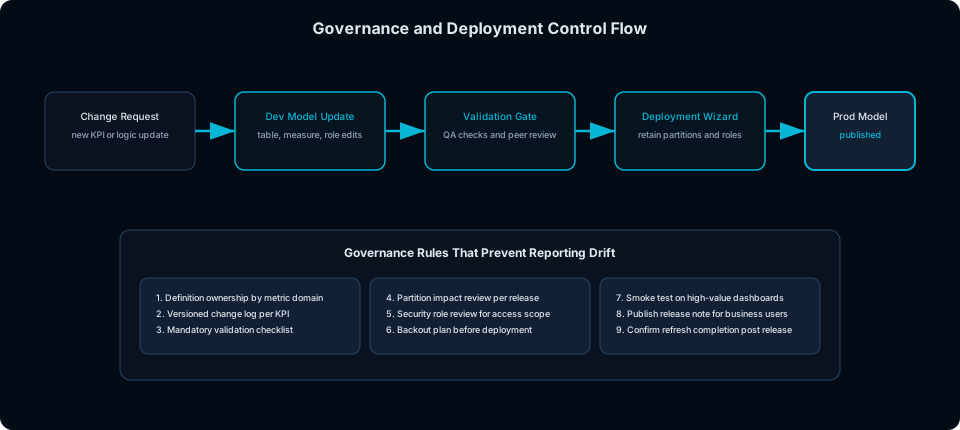
Governance is what keeps the semantic model trustworthy after the first release, especially as KPI volume grows.
The Three Release Gates
Gate 1: Owner approval
What it is. Every KPI change requires written approval from the domain owner before it can enter a release, in the form of a published change summary with five fields: the business definition, the formula change, the impacted dashboards, the validation evidence, and the expected number movement.
Why it matters. The approval is not a rubber stamp. It is the record that says “the owner of this metric agreed to this change”, which means future questions about the change have a documented answer instead of a tribal one. The five-field contract also forces the change author to think through impact before requesting approval, which catches most “I didn’t realise that touched X” problems at the cheapest stage.
What goes wrong without it. Approval becomes a rubber stamp. Silent metric drift starts here: an owner approves the change name without reviewing the formula, the dashboard team finds out post-release, and the model loses its trust capital one change at a time.
Gate 2: Validation
What it is. A release that has passed approval still has to pass validation. A measure regression suite runs against pre-release baselines for every changed measure. Role-and-access checks confirm that the model’s security graph is unchanged unless the release explicitly modifies it. Smoke tests run against the top business dashboards in a staging environment that points at the new model.
Why it matters. A release that fails validation does not deploy. The cost of stopping at this gate is one day; the cost of deploying a release that fails validation is whatever it takes to roll back, plus the trust the team loses with the business. Validation is also where unintentional changes surface: a measure edit that affects an unrelated KPI shows up as a regression-suite delta on a measure the change author did not realise touched.
What goes wrong without it. Releases ship with regressions that the team finds out about from the business, not from the pipeline. By the time the regression surfaces in a leadership review, the deployment is days old and the rollback is expensive. Release confidence drops, and conservative cadence (releasing once a month to be safe) replaces fast iteration.
Gate 3: Rollback path
What it is. Before a release deploys, a written rollback path exists. The previous artefact is identified. The partition-refresh fallback is documented. The communication plan for affected users is drafted.
Why it matters. The first ten minutes after deploy are the ones where rollback is cheap; ad-hoc rollback during an incident is expensive and slow. The Friday-evening incident in the opening anecdote is a worked example of what happens when the rollback path is not pre-defined: a deployment that reset partitions and roles took three days to recover, when a pre-defined rollback would have taken thirty minutes. The discipline matters most on platform-migration paths, where the tabular engine can reset partition state and role configurations if a deployment safeguard is not explicitly set.
What goes wrong without it. Rollback during an incident becomes a research project. The team that wrote the original deployment script has to reconstruct the previous state from logs, source control, and memory, while leadership is asking for an ETA the team cannot give. The next release after the incident is conservative to the point of being slow, and the cadence loss is a multi-quarter problem.
Where I would start
If you can only stand up one gate this quarter, stand up Gate 3 (rollback path). The first two gates protect against regressions and silent drift, both of which are real but slower-moving failure modes. Gate 3 protects against the catastrophic-and-fast failure mode where a release brings down dashboards for a day. The cost of one undocumented rollback during a real incident exceeds the cost of building Gate 1 and Gate 2 together.
Gate 1 (owner approval) ships next because the published change summary becomes the input contract for Gate 2’s regression suite. Gate 2 (validation) ships last because it requires the regression baselines and smoke-test infrastructure that the first two gates surface as needed.
One MENA-flavored note
Release gate cadence in Arabic-OTT needs to read the Ramadan calendar. The two weeks before Ramadan and the four weeks of Ramadan itself are the highest-visibility window of the year for executive dashboards. A failed release in this window costs a year of trust to rebuild, because the dashboards are being read at the moment leadership cares most about what they say. The practical implication: freeze non-critical semantic-layer releases in the two weeks leading into Ramadan and run only fully-rehearsed rollback-tested releases during the window itself. The cycle awareness is operational, not seasonal flavour; the release calendar aligns to the content cycle, not the working week.
Closing
If your model deployed today and broke production, would you know how to roll back?
If the answer requires “let me ask the engineer who built it,” the rollback path is not documented and the third release gate is missing. If the answer is “yes, here is the previous artefact and the partition refresh sequence,” the gates are doing their work. The model is the part that gets attention. The release discipline is the part that decides whether the model survives the next deploy.