CRM Campaign Automation Platform
Daily CRM campaigns that build and target themselves across millions of profiles, replacing multi-day audience handoffs with hands-off execution.
Millions
Profiles Processed Daily
4
Recommendation Scenarios
Multi-week
Deduplication Window
Challenge
A recurring campaign should not need a human in the loop, yet every send started the same way: a CRM team raised a data request, an analyst wrote a query, and the audience came back a day or two later, often too late for the send window. The cadence was capped by how fast people could pass files between each other.
For a large subscription-based consumer business sending daily, that gap compounds. The targeting platform could only address an account, but the people inside a shared account behaved differently, so everyone on the account got the same message regardless of who was actually active. And when content priorities shifted on a calendar, somebody had to redeploy logic to match.
- Audience builds were a manual analyst bottleneck, so campaign cadence was set by query turnaround rather than by what the data could support.
- Targeting stopped at the account level and ignored the multi-profile structure underneath, flattening the per-person signal that makes a recommendation feel relevant.
- Scheduling, deduplication, and delivery were handled ad hoc, with no systematic record of who had already been sent what.
- Setup logic and outcome analysis lived in separate workflows, so there was no loop connecting targeting decisions back to performance.
Approach
Two calls carried the rest of the work.
The first was the grain. I could have processed at the account level, which is simple and matches what the delivery platform accepts, but it throws away the per-person behavior that makes a recommendation worth sending. So I processed at the profile level and rolled up to the account only at delivery, picking one primary profile per account. The rollup method stayed configurable (primary, dominant, or last-active) so the same engine could serve different campaign intents without a rewrite, while still landing inside the platform’s account-level constraint.
The second was how a winner gets chosen. Each account was usually eligible for several recommendation scenarios on the same day, but a single send delivers one message, so the system needed a deterministic tiebreaker. A fixed calendar rotation was predictable but blind to behavior, so I made behavior-based prioritization the default and kept calendar rotation as a fallback. The rule keys off recency: someone active in the last week is best served by re-engagement, someone quiet for a few weeks by trending discovery, someone dormant longer by cluster-based discovery. Matching the scenario to where a profile sits on the recency curve beats sending whatever the calendar happened to surface.
Around those two decisions sat the build:
- A three-stage shared data prep layer: catalog metadata rollup from item to group to category, profile-to-region mapping across regional segments, and a filter down to eligible active profiles.
- Four parallel recommendation scenarios, each a nine-step pipeline: load, filter, join eligible profiles, apply item and category filters, exclude already-seen items, exclude recently sent, rank the top five per profile, write, and validate.
- An account rollup that unions every scenario output, selects one profile per account, and attaches the delivery identifier the platform expects.
- A scenario selector that runs RFM-based segmentation into a subscription versus ad-supported treatment split, then applies the recency-based prioritization to pick one item per account.
- A temporal configuration system where seasonal overrides activate and deactivate by date on their own, turning a content-priority shift into a config change rather than a release.
- A delivery phase that writes the payload with multi-week deduplication tracking, so a profile does not get the same recommendation twice inside the lookback window.
Results & Impact
- Audience creation moved from multi-day analyst handoffs to hands-off daily execution, and the recurring data requests that used to gate every send stopped entirely.
- Targeting shifted from undifferentiated blasts to behavior-segmented scenarios, with recency routing, regional trending, and cluster-based discovery all driven by configuration rather than code, so CRM teams now own scenario logic without touching the pipeline.
- Predictable recurring windows where content priorities shift now activate by date through temporal configuration, removing the emergency deployments and manual overrides that used to land during peak periods.
- Multi-week deduplication per profile holds notification fatigue down: the same item will not reach the same profile inside the window, no matter which scenario generated it.
Architecture
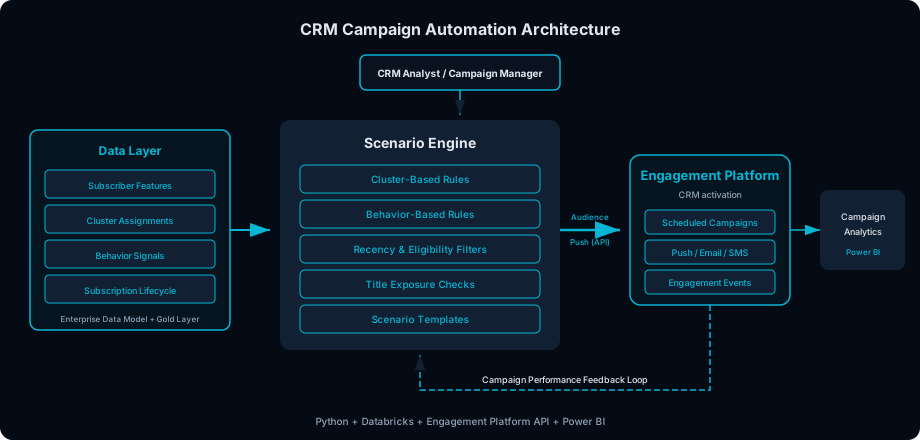
The daily pipeline runs in five phases. Shared data prep feeds four parallel scenario generators (cluster-based discovery, re-engagement, trending discovery, and an ad-supported-tier scenario), which roll up to the account level, pass through behavior-based scenario selection, and deliver to a customer-engagement platform with a multi-week deduplication window wrapping the whole flow.
Tech Stack
- Platform: Databricks on AWS (PySpark + Spark SQL)
- Storage: Delta Lake (S3) with ACID transactions on scenario output and infra tables
- Orchestration: Databricks Jobs (daily batch scheduler)
- Delivery: Customer-engagement platform (push notification targeting)
- Reporting: Power BI (campaign performance tracking)
- Environments: Development to Production promotion via Databricks workspace environments
My Role
I owned this end to end: the profile-level grain and rollup, the four scenario pipelines, the behavior-based selector, the temporal override system, and the deduplication tracking that keeps it honest at scale. I built it to run unattended on a daily schedule and to be driven by configuration so the teams downstream could change targeting without coming back to me. The pattern transfers to any subscription or engagement-driven product where a delivery platform targets coarser than the behavior signal warrants and recurring sends still depend on manual audience builds. It earns its keep at volume; below a few thousand users, or where the delivery platform already does behavioral segmentation natively, the scenario layer is overhead rather than leverage.