Why Most Semantic Layers Fail: The Conflict-First Rollout
Semantic-layer programs collapse into four predictable traps because they are scoped like engineering projects. Here is the rollout that breaks all four.
The first Monday of a quarterly review opened with the three-different-numbers slide. Three teams, three counts for “monthly active subscribers” in the same month. The subscriptions team had one number. The engagement team had a higher one. The ad-ops team had a lower one. None were technically wrong. Each had been calculated against a different filter assumption: trial users included or excluded, internal accounts in or out, household-shared profiles counted once or per device.
Twenty minutes of that meeting was spent deciding which number to use as the headline. None of it was spent on the actual decision the leadership team had walked into the room to make.
That kind of reconciliation is the scene where most semantic-layer projects get kicked off. The phrase used in the kickoff is “we need a semantic layer.” The phrase that should be used is “we need a governance product.”
A semantic-layer team is either shipping a dataset or running a governance product. Once it ships a dataset, the model is technically correct on day one and bypassed by week three, because building a local DAX measure took five minutes and asking for a model change took two weeks; once it runs a governance product, the same KPI authored once is consumed everywhere, drift stops being structural, and AI agents inherit a defensible metric definition. The way you get there is not a bigger schema or a longer rollout phase. It is a Conflict-First Rollout: six weeks of conflict mapping that produces the scope, the ownership, and the release discipline the rest of the program inherits.
Why this matters now
The pressure on the semantic layer is increasing, not decreasing. In the dbt 2025 State of Analytics Engineering Report, 27% of teams said they plan to increase investment in semantic-layer tooling over the next twelve months. AtScale’s 2025 review frames this as a shift from “semantic layer as nice-to-have” to “semantic layer as required infrastructure for LLM-driven analytics.”
The reason is straightforward. The moment an AI agent answers a question in natural language, the answer is only as good as the metric definition behind it. As Atlan puts it, without a centralized semantic layer “every BI tool, every notebook, and every AI agent maintains its own translation logic, and when those translations drift, data teams spend days reconciling reports instead of building new ones.” Metric drift was already expensive when the only consumers were dashboards. With AI consumers added to the picture, drift now ships wrong answers to executives in chat.
So the projects get funded. They start. And then most of them collapse into one of four traps.
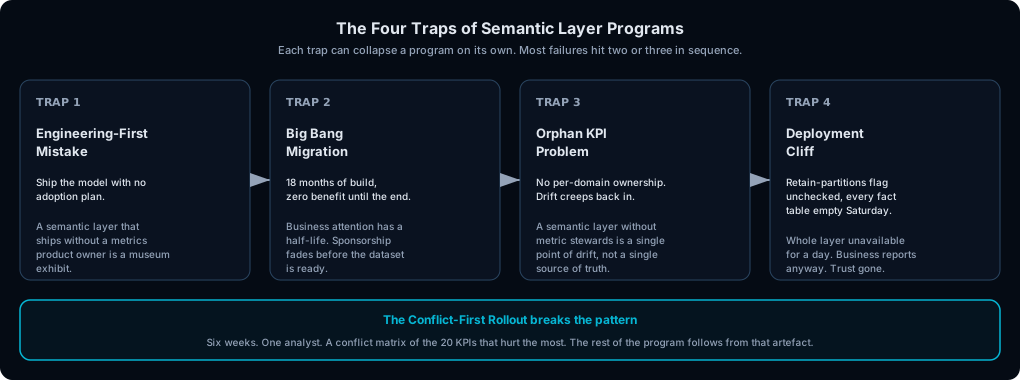
The four traps map the typical failure path. Each trap on its own can collapse a program, and most failures hit two or three in sequence.
The Four Traps of Semantic Layer Programs
The four traps below are the typical failure path. Each trap on its own can collapse a program. Most failures hit two or three in sequence. The “what to do instead” answer under each trap is one component of the Conflict-First Rollout; together they form the framework.
Trap 1: The Engineering-First Mistake
What it looks like. The data-engineering team scopes the project, picks a semantic-modeling platform, models the schema, ships a beautiful dataset, then waits for adoption. Adoption does not come. Report teams keep building local DAX because nobody onboarded them to consumption mode, the measure documentation is in a wiki page no one can find, and the change-request queue is unstaffed.
Why it kills the program. A semantic layer that ships without an adoption plan is a museum exhibit. The model can be technically perfect and still get bypassed in week three, because building a local report-file measure took an analyst five minutes and asking for a model change took two weeks.
What to do instead. Scope the program with two co-leads from day one: a data-engineering lead for the model and a metrics product owner for the rollout. The second role is the one that gets cut first under budget pressure, and it is the one whose absence kills the program.
Trap 2: The Big Bang Migration
What it looks like. A plan that migrates every existing measure into the semantic model before any consumer switches over. Eighteen months of build, zero business benefit until the end. By the time the model is “ready,” the original sponsors have moved on, the business case has shifted, and the dataset is now in catch-up mode against six months of new requests.
Why it kills the program. Business attention has a half-life. A rollout that delivers nothing for six months has already lost half its sponsorship. By twelve months it is a budget line nobody can defend. The most common cause of semantic-layer cancellation is not a technical failure. It is a calendar failure.
What to do instead. Start with the 20 to 30 KPIs that trigger the most reconciliation effort. These typically cluster across the domains that drive most cross-team reconciliation: subscriber lifecycle, engagement, content performance, and monetization. Not one hundred KPIs at once. Ship a pilot dataset against three or four high-pain dashboards in six weeks. Then expand by domain, not by table. Each expansion is a release that the sponsor can point to.
Trap 3: The Orphan KPI Problem
What it looks like. The model ships, ownership for individual KPIs is implicit, and within three months unreviewed measure edits start drifting back in. Someone tweaks the churn formula to fix a finance request, no one writes it down, the engagement team’s dashboard now reads differently, and nobody can explain why in five minutes.
Why it kills the program. A semantic layer without per-domain ownership is a single point of drift, not a single source of truth. Trust degrades silently as the model ages. By the second year, half the teams have re-introduced local logic “just in case,” and the layer is back to being one consumer among many.
What to do instead. Assign explicit metric stewards by domain: subscriber lifecycle, engagement, monetization, content performance. Every KPI gets a named owner. Every change runs through a defined release cycle with seven fields published per measure: business definition, formula, grain, included segments, excluded segments, validation query, last approved date. This is the contract that turns a dataset into a product. Chad Sanderson frames it as “data as a product”: the semantic layer is one component of a data product, alongside product management, business logic, and access. A project ships once. A product is owned, versioned, and supported.
Trap 4: The Deployment Cliff
What it looks like. A Friday-evening deploy clears a deployment safeguard that was off by default. Saturday morning every fact table is empty. Sunday is spent restoring partitions from backup. Monday’s dashboards are wrong, and Monday’s leadership meeting happens anyway.
Why it kills the program. The failure mode that destroys trust most efficiently is not “the model is slow” or “this measure is wrong.” It is “the entire layer was unavailable for a day and the business reported anyway.” After one of these incidents, every team in the building rebuilds local logic as insurance, and the deal is off.
What to do instead. Codify release discipline before the first production deploy. Retain partitions and roles. Run dual reporting for one or two refresh cycles after every model change. Document a rollback path that takes minutes, not days. The partition strategy ran on tiered cadences: one-day for engagement, five-day for subscriber base movement, and a multi-week window for late-arriving attribution data because programmatic ad attribution settles over an extended period. Each cadence had its own rollback procedure, written down before anyone touched production.
Where I would start
If you have the 20 KPIs that hurt most, you do not have a semantic-layer project. You have a conflict map. That is the first move of the Conflict-First Rollout, and every other move follows from it.
The first six weeks of a semantic-layer program should be one analyst, one product-aligned data lead, and one stakeholder per domain producing a single artefact: a conflict matrix. For each high-pain KPI, capture what the formula is in every dashboard today, who owns it, what the business actually means, and what the canonical definition should be. Not a tool selection. Not a schema. Not a partition strategy. A matrix.
Three things follow from the matrix, in order. The semantic-layer scope shrinks from “rebuild everything” to “fix the twenty KPIs that broke the last quarterly review”, which neutralises Trap 2. Domain ownership becomes obvious because every conflict has a natural home, which neutralises Trap 3. The first production deploy is a forty-measure dataset shipped in six weeks, not a four-hundred-measure dataset shipped in eighteen months, which means the metrics product owner role from Trap 1 has time to onboard report teams to consumption mode before the model goes live. Trap 4 stays the last to neutralise because release discipline is a habit, not a one-time decision.
Each of these shifts buys back trust before sponsorship fades. The matrix is what makes the program a governance product instead of an engineering project.
One MENA-flavored note
In Arabic-OTT there is a practical reason the conflict-first rollout pays off quickly: the Ramadan cycle. Pre-Ramadan, in-Ramadan, and post-Ramadan windows shift content launches, subscription patterns, ad inventory, and engagement curves. Every “monthly active” or “average watch time” KPI you build needs a time-grain stance on these windows. The dim-date table carries explicit Ramadan flags (minus-30 days, in-Ramadan, plus-30 days) so that every measure can answer the same question consistently across the cycle. If this is not solved in the semantic layer, every team solves it in their own report file. That is the Orphan KPI Problem in slow motion, on an annual schedule.
Closing
Is your semantic layer a strategic asset or a maintenance liability?
The teams that treat it as a maintenance liability ship a beautiful dataset, lose sponsorship, and watch adoption collapse. The teams that treat it as a strategic asset run it as a product: owners per domain, versioned releases, conflict-first scope, deployment discipline. The Conflict-First Rollout above is the path from one to the other. The work is in the matrix.