Semantic Layer Series Part 6 of 6: The Weekly Optimization Cycle
A weekly cycle that turns monitoring telemetry into prioritised fixes, before slow queries become a trust problem.
A high-traffic visual that used to render in two seconds turned into a thirty-second render by the time leadership saw it. The model had not changed. The data had not changed. The query had gotten slower week by week and nobody had been watching.
That kind of degradation is how semantic-layer programs lose trust slowly, then all at once. The refresh succeeds. The model builds. The KPI definitions stay correct. The queries get slower over time, the visuals get heavier, the report estate accretes weight, and one Wednesday afternoon a single thirty-second render in front of an executive turns the whole program into a question.
A semantic-layer team is either running monitoring as a weekly operating loop or running it as a passive dashboard. Once it is passive, slow queries get slower week by week, alerts get muted as noise, and the first signal that something is wrong arrives in a leadership review; once it is an operating loop, monitoring telemetry becomes a closed-loop process where every flagged item has a layer, an owner, a target date, and a verification gate. The way you get there is not more alerts. It is The Weekly Optimization Cycle: four stages run every week in the same order, each one named, each one with the discipline that keeps the loop from decaying.
Why this matters now
Semantic-layer maturity is decided after the launch is forgotten. The first six months are about correctness: are the measures right, do the dashboards render, does the deployment hold. The next twelve months are about decay: queries that used to render in two seconds taking thirty, capacity pressure that nobody is tracking, model drift that surfaces only when a senior stakeholder asks why a report is slower than it used to be.
The fix is not more monitoring tooling. Most semantic-layer programs already collect enough telemetry to spot the decay; what they lack is the operating discipline to turn telemetry into fixes. The Weekly Optimization Cycle below is the operating rhythm that closes the loop, and the four stages are what each weekly meeting actually does.
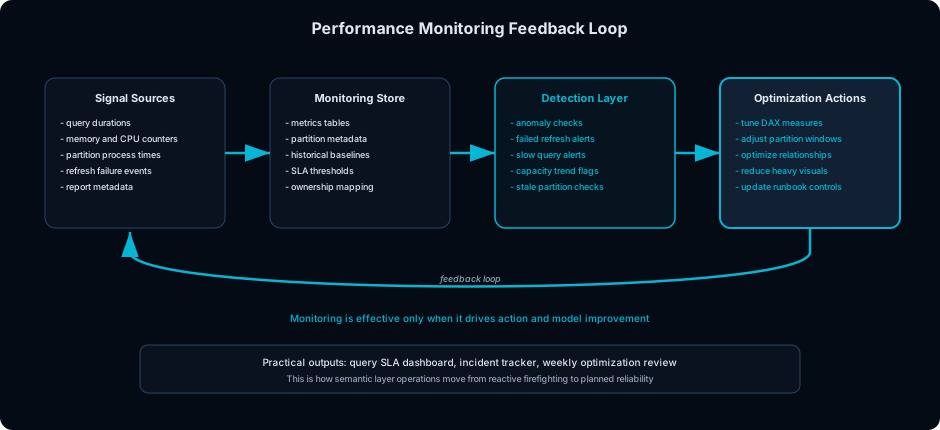
Monitoring only creates value when it triggers optimization actions, ownership, and measurable improvements.
The Weekly Optimization Cycle
Stage 1: Review
What it is. A weekly review of monitoring telemetry: top incidents from the previous week, slow-query clusters, refresh latencies that drifted, capacity pressure flagged by the monitoring tables. The review happens before the week starts, ideally before the dashboards open Monday morning.
Why it matters. The review is the moment monitoring data becomes operational. Telemetry that nobody reviews is telemetry that collects, costs to store, and accomplishes nothing. The weekly cadence also prevents the review from becoming optional: it has a slot on the calendar, an attendee list, and an artefact (the cycle’s output).
What goes wrong without it. Slow queries get slower week by week and nobody is watching, because the alerts that should have caught them got muted as noise during a baseline shift the team forgot to disable. The first signal that something is wrong arrives in a leadership review.
Stage 2: Map
What it is. Each flagged item gets traced to its cause layer: model, refresh, or report. A slow query whose root cause is a poorly composed visual is a different fix from one whose root cause is a measure that needs a relationship optimisation; the layer attribution determines who picks it up.
Why it matters. Without layer attribution, every monitoring alert lands in the same triage queue and gets fixed by whoever has bandwidth. The fix often happens in the wrong layer (a report-level workaround for a model-level problem), which masks the underlying issue and pushes the real fix to the next quarter. Mapping is what keeps each layer’s owner accountable for their own backlog.
What goes wrong without it. Fixes happen in the cheapest layer rather than the right one. A poorly composed visual gets “fixed” by adding caching at the report level, when the real fix is a measure optimisation that would speed up every report. Technical debt accumulates in the layer above where the problem actually lives.
Stage 3: Assign
What it is. Every flagged item gets a named owner and a target close date. No item is left “to investigate” without an owner.
Why it matters. Ownership is the discipline that turns a monitoring backlog into a closed-loop process. An item with an owner has a path to resolution; an item without one is a queue entry that decays into noise. The target close date forces a follow-up at a specific time, which is what brings the item back into the next Review even if the owner has not had time to close it.
What goes wrong without it. Items get marked “to investigate” and sit there indefinitely. The backlog grows. New monitoring alerts compete with old ones for attention. Eventually the team stops trusting the monitoring queue and operates from memory and intuition, which is where the cycle dies.
Stage 4: Verify
What it is. Each fix shipped in the previous week is checked against the metric it was supposed to improve. Items return to baseline before they close.
Why it matters. Verify is the discipline that prevents fixes from being declared done without evidence. A measure optimisation can be “shipped” without actually moving p95 query duration if the optimisation targeted the wrong query plan; verifying against the original metric is what catches that case. The discipline also feeds back into the next Review: confirmed-not-fixed items return to the backlog automatically.
What goes wrong without it. Fixes accumulate as shipped-and-uncertain. The backlog “drains” but the symptoms persist, and three months later the team is rediscovering the same slow queries because nobody confirmed the original fixes landed.
Where I would start
If you can only implement one of the four stages this quarter, implement Verify. The first three stages produce a list of flagged items, owners, and target dates; without Verify, the team works through the list, marks things done, and discovers three months later that the symptoms never went away because the fixes did not land where the symptoms lived. Verify is the discipline that makes the previous three stages worth running.
Review ships next because Review is where the cycle starts: no Review means no items to map, assign, or verify. Map and Assign get tighter over time as the team learns its own taxonomy of failure modes and natural owners; the initial week can run with fuzzy layer assignment and still produce useful output.
One MENA-flavored note
The Weekly Optimization Cycle has to read the Ramadan content cycle to stay useful. Query patterns during Ramadan are different from the rest of the year (higher visual interaction, sharper segment-level drilldowns, sustained late-night load), and a baseline calculated against non-Ramadan traffic will alarm on every dashboard during the window itself. The fix is to maintain two baselines: a standard baseline for the forty weeks outside the Ramadan cycle, and a Ramadan-window baseline that the alerting rules switch to during the four-to-six weeks of pre-Ramadan and Ramadan traffic. A monitoring stack that does not know about the cycle generates noise that gets muted, which is how the loop dies.
Closing the series
You have spent six posts on the semantic layer. Has yours moved from project to product?
A project ends when the model is built. A product is monitored, owned, versioned, and optimised every week. The arc of the series traces what it takes to make the transition: a Conflict-First Rollout in Part 1, Three Ownership Layers in Part 2, the Three-Layer DAX Stack in Part 3, the Three Release Gates in Part 4, the Six-Stage Refresh Loop in Part 5, and the Weekly Optimization Cycle here in Part 6. None of these is technically novel. The discipline of running all six at the same time is what separates the semantic layers that compound from the ones that quietly atrophy.
If the Weekly Optimization Cycle is the only thing you adopt from this series, adopt that one. It is the rhythm that keeps the other five disciplines alive.