The Three-Phase BI Migration Sequence
A three-phase BI migration (tool, then data layer, then metric logic) replaces big-bang cutovers with validated swaps that survive when numbers move.
The mid-cutover review opened with two numbers for the same KPI: the new platform’s and the old platform’s, same reporting period, three percent apart. The executive sponsor asked the room which one to ship to the board next week. The team had migrated the BI tool, the data layer, and a hundred KPI definitions in parallel. There was no honest way to point at a single layer and say “that is where the difference came from.” The three percent might have been the new metric definition, the new data join, or the new rendering. “We’ll come back with a reconciliation” was the only available answer.
That conversation does not end with the reconciliation. It ends with leadership going around the new platform to ask the operations team for its spreadsheet, because the spreadsheet does not have a layer ambiguity. Within a quarter the modernization that was supposed to consolidate trust has accidentally dispersed it.
A BI modernization team is either swapping one layer at a time or defending three at once. Once it starts defending three at once, every reconciliation is a three-variable problem and every executive question becomes a deferred answer; once it starts swapping one at a time, the team always has a layer to point at when the number moves. The way you get there is not a bigger validation team or a longer testing window. It is a deliberate sequencing of the cutover into three independent phases that can each be validated against the previous one.
Why this matters now
BI tool migrations have become routine across enterprises, but the structural failure mode has not changed: organisations attempt single-step migrations and spend two years rebuilding trust. Migrations of this scope routinely run double the original estimate, and the root cause is almost always compounding change across layers that should have been migrated separately.
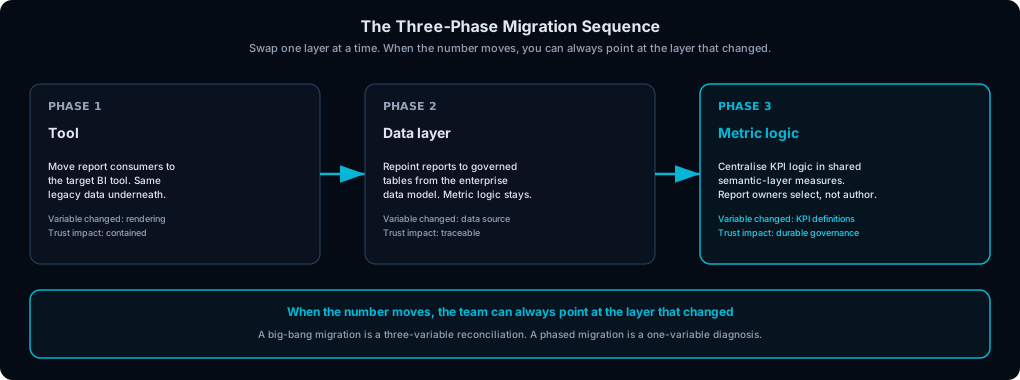
A big-bang migration is a three-variable reconciliation. A phased migration is a one-variable diagnosis.
The Three-Phase Migration Sequence
Phase 1: Tool
What it is. Move report consumers to the target BI tool with continuity against legacy data sources. Reports rebuilt in the new tool, still pointing at the same legacy data. Nothing changes about the data layer or metric definitions yet.
Why it matters. The questions that arise during this phase are formatting, navigation, and minor behavioural differences between the source and target BI tools, not “why is this number different from last week.” The one variable that changed (the tool) is the one variable available to explain any difference, which keeps reconciliation tractable.
What goes wrong without it. The team migrates tool, data, and metric simultaneously. A report-owner says “this number looks wrong.” Nobody can tell whether the new tool rendered it differently, the new data layer returned a different value, or the migrated measure has a slightly different definition. Every reconciliation is a three-variable problem.
Phase 2: Data layer
What it is. Repoint reports to governed shared data assets. Reports continue running in the new BI tool; the underlying data source switches from a legacy table to a governed table from the enterprise data model. Metric logic still lives in the report file, unchanged from Phase 1.
Why it matters. Every report now consumes the same governed, modelled data. Filters, dimensions, and grain are aligned across the estate, and the “why does Subscriber Count differ between the Content report and the Subscriptions report?” conversations stop being unanswerable. The estate becomes governed all the way down to the source, not just at the visual layer.
What goes wrong without it. Report owners author measures against legacy sources or against the new model inconsistently, and the estate ends up half-governed and half-not. Two years later the maintenance cost of the legacy half is the same as it was before the migration.
Phase 3: Metric logic
What it is. Centralise KPI logic in a semantic model. Measures move out of individual report files into shared semantic-layer measures consumed via live connection. Report owners shift from authoring measures to selecting them.
Why it matters. KPI definitions live in one place instead of being scattered across individual report files, and an update to a metric happens in one place instead of across every report file that uses it. This is the layer that turns the modernization into durable governance: the tool and the data layer can change again later without rewriting metric logic.
What goes wrong without it. The semantic-layer governance benefit never materialises. Reports stay individually authored, drift continues, and the modernization program has spent its political budget on a tool change and a data-layer migration without delivering the durable trust improvement that justified the work.
Four release disciplines
Cutover runbooks. Every major cutover needs a written runbook: the sequence of steps, the validation checks to run before and after, the rollback procedure, and the communication plan for affected stakeholders. The runbook removes ambiguity during the most fragile moments of each phase. The first time something does not behave as expected during cutover, the team is grateful for the runbook.
Pilot dashboards before broad rollout. Migrate two or three representative dashboards first, validate with primary stakeholders, then proceed to the broader rollout. This catches data-source mismatches, formatting differences, and performance regressions before they affect the full estate.
Explicit deprecation of report-local KPI logic. In Phase 3 it is not enough to ship the semantic layer and hope teams adopt it. Local DAX needs to be removed as the corresponding shared measure goes live. Without explicit deprecation, both the old and new approaches coexist indefinitely and the governance benefit erodes.
Named owner per phase. Each phase needs a single named owner responsible for delivery, communication, and issue resolution. Migration is the worst possible activity to manage with shared accountability.
Where I would start
The three phases are the end state. The way to actually arrive at them is sequential, and the trade-off is dictated by political budget, not by engineering capacity.
If you have one quarter and the budget for one phase, do Phase 1. Phase 1 produces visible progress (every report runs in the new tool) without risking the layer that backs every leadership conversation. The questions that come back are formatting and navigation, not “why is this number different.” Trust survives, and the team builds the operational muscle the next two phases depend on: a written cutover runbook, a pilot-then-broad-rollout cadence, a named owner per phase.
Phase 2 ships next, because once everyone is on the new tool, the highest-leverage move is to put everyone on the same governed data. The political budget for Phase 2 is earned through Phase 1, not assumed. Skipping Phase 2 leaves the estate half-governed and the maintenance cost roughly where it started.
Phase 3 is last because metric logic is the layer that is hardest to undo. Centralising KPI definitions only makes sense after the data layer is stable, and only delivers durable trust after the consumer base has learned the new tool well enough that the metric change is the only variable in the room.
One MENA-flavored note
Modernization programs in MENA streaming intersect the Ramadan content cycle at least once during a multi-year sequence. The dashboards used during Ramadan release reviews are the highest-visibility reports of the year, and a cutover scheduled mid-Ramadan lands a still-stabilising platform on the moment leadership is paying the most attention to it. The trust cost of a single anomaly in that window takes a year to rebuild. Cutover windows align to the cycle, not the calendar. The cycle awareness is operational, not seasonal flavour.
Closing
If your migration broke today, which layer would you point at first?
The answer is the test for whether the program is recoverable. A team that can point to a layer can fix the layer; a team that swapped tool, data, and metrics simultaneously can only roll back the whole migration or absorb the cost. The Three-Phase Migration Sequence above exists so the answer is always available, and so the answer is always a fix and not a retreat.