Attribute Inference in Practice: The Four Guardrails
Lifting profile coverage from sparse to near-full across millions of users, and the four guardrails that decide whether inferred data helps or harms.
A content team asked a planning question: what does the female audience over 25 actually watch? The honest first answer was that only a quarter of adult profiles had self-reported gender data. The rest was unknown.
Twelve months later, the answer to the same question was a governed BI report with near-full coverage across millions of adult profiles, the majority of those rows being entirely new predictions on profiles that had no gender data at all. The model behind that report held above a reasonable AUC threshold on a held-out validation set restricted to single-adult-profile accounts.
That kind of coverage shift is the part most teams celebrate. It is also the part that matters least. Building a behaviour-based gender inference model is not hard. Convincing the planning team to treat an inferred field like inferred data, not like ground truth, is the work.
An inference model is either shipped with receipts or treated as ground truth. Once it is treated as ground truth, the first wrong prediction on a high-profile case ends the program, because nobody warned the consumers that the field was probabilistic; once it ships with receipts, the prediction, the confidence flag, and the inferred marker travel together, and downstream consumers learn to threshold instead of trust blindly. The way you get there is not a better model. It is four guardrails that turn an enrichment from a risky field into a published data product.
Why this matters now
Attribute inference is back in the spotlight, in part because explicit demographic collection is under increasing regulatory and platform pressure. Meta’s post-iOS-14 ad-targeting documentation and similar shifts have pushed advertisers toward inferred attributes. Streaming platforms that depend on declared-attribute targeting are running out of declared data faster than they are gaining it.
MENA streaming has a sharper version of the same problem. Household profile-sharing is structurally higher than Western baselines, profile completion rates are lower, and demographic targeting is essential for both content planning (which Ramadan finale to promote to which segment) and ad operations (which AVOD inventory to allocate to which demographic). Without inference, planning teams are flying half-blind. With inference but no guardrails, planning teams are flying on a confident hallucination.
The four guardrails below are what makes the difference. Each is independent. Together they make the inferred field defensible.
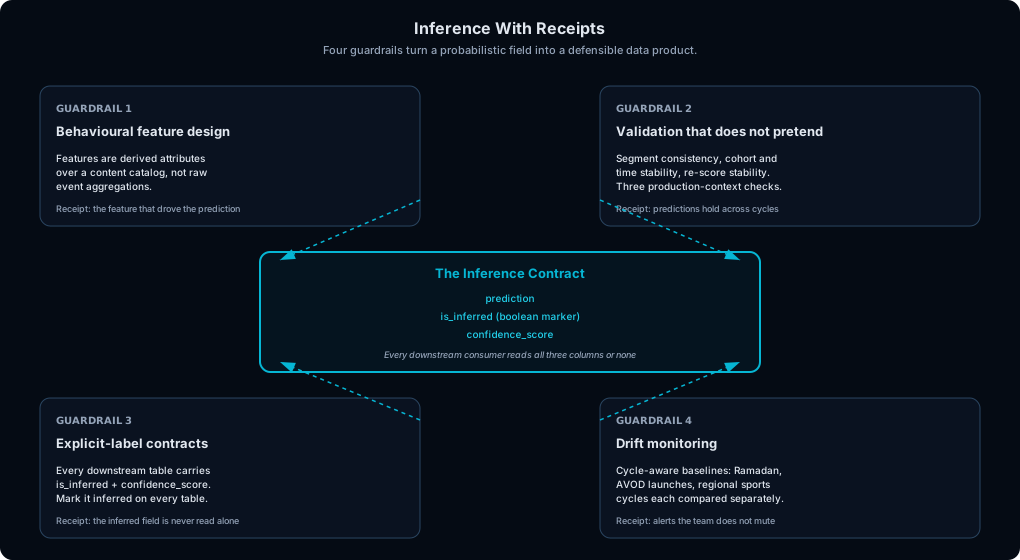
Each guardrail closes one failure mode. Together they turn the inferred field into a published data product instead of a quietly probabilistic one.
Inference With Receipts
Guardrail 1: Behavioural feature design
What it is. The model is built on the premise that what someone watches carries more demographic signal than what they choose to fill in on a profile form. The top predictive feature was protagonist gender, followed by audience affinity scores and sub-genre preferences. The features that drive accuracy are not raw event signals; they are derived attributes that join viewing logs against a content catalog enriched with cast composition, sub-genre tags, and audience affinity segments.
Why it matters. The receipt for a prediction is the feature that drove it. A model built on derived behavioural attributes can answer “why is this profile flagged female?” with a concrete signal: the protagonist gender on the most-watched titles, the affinity-score profile, the sub-genre mix. A model built on opaque event aggregations cannot, and that lack of receipt is the moment trust evaporates the first time a content lead pushes back.
What goes wrong without it. Teams build inference on top of incomplete content metadata and produce models whose predictions cannot be defended when challenged. The first time a content lead asks “why is this profile flagged female?” the team has no answer because the features were opaque event aggregations.
Guardrail 2: Validation that does not pretend
What it is. Three production-context checks beyond held-out test accuracy:
- Segment consistency. If the model says a profile is female, the profile’s behaviour aligns with verified female users in the same cohort. Sanity check, not a confidence interval.
- Cohort and time stability. A model that predicts one way in January and flips in March is worse than useless for planning teams that build campaigns weeks in advance. Stability across content release cycles is non-negotiable.
- Re-score stability. A profile that gets re-scored weekly should not flip predictions unless behaviour genuinely changed. Erratic re-scoring erodes trust faster than slightly lower accuracy.
Why it matters. Accuracy on a held-out test set is table stakes. The harder validation is whether the predictions behave sensibly in production context, where planning teams build campaigns weeks in advance against a stable definition of who their audience is. A model that passes ML-team accuracy and fails any of the three production checks above ships and dies anyway.
What goes wrong without it. A model that passes ML-team validation but fails business-team validation. The content team sees flip-flopping predictions, starts ignoring the inferred field, and the model is dead in production six months after launch.
Guardrail 3: Explicit-label downstream contracts
What it is. Every downstream table carries an is_inferred marker and a confidence flag. No consumer of the data is allowed to read the inferred attribute without also reading those two columns. An inferred field is not a declared field, and downstream dashboards have to surface that uncertainty.
Why it matters. The contract is what stops the inferred field from quietly becoming “the gender field” three quarters after launch. Without explicit labelling, the BI team will absorb the inferred column into the same templates that read declared data, and the model’s predictions will be presented as ground truth in executive reporting. Mark it inferred, every time, on every table.
What goes wrong without it. A probabilistic model gets cited as fact in a leadership presentation. The first time the prediction is wrong on a high-profile profile, the program loses credibility, and credibility lost on inferred data is hard to win back.
Guardrail 4: Drift monitoring with cultural context
What it is. A cycle-aware drift monitor: Ramadan and non-Ramadan windows are compared separately, AVOD-launch periods are flagged as known shifts, and re-training is triggered only when within-cycle drift exceeds a threshold.
Why it matters. Viewing patterns shift with content releases, Ramadan schedules, AVOD launches, regional sports cycles. A drift monitor that assumes stable feature distributions across these shifts will alarm on every cycle and become noise that gets muted. Western-baseline drift heuristics do not transfer because the cultural cycles are different; the monitor has to know which baseline to compare against, or its alerts get permanently silenced and the model goes stale unnoticed.
What goes wrong without it. Either the model goes stale (no monitoring) or the monitoring becomes noise (wrong baseline). Both end the program.
Where I would start
If you have one dashboard and one alert to set up around an inference model, do not pick accuracy.
Pick re-score stability. The single highest-leverage signal that the model is healthy in production is whether profiles flip predictions between scoring runs. A drop in re-score stability is the first sign of any of three failures: feature pipeline drift, content-metadata corruption, or genuine population shift. Each of those is worth investigating; the stability signal catches them all.
Second priority: a sample-of-the-week qualitative review with the content team. Twenty random profile predictions, walked through with the planning lead, every week. The numbers tell you that the model is statistically sound. The qualitative review tells you whether the predictions are usable. The two together cover the gap that pure accuracy reporting always leaves.
Third priority: the is_inferred and confidence columns ship with the first downstream table the model writes into. Not the second. Not “we’ll add it in v2.” Day one. The reason is path dependence: once a downstream consumer has built a dashboard against the inferred column without the marker, getting them to retrofit the marker is an enterprise-wide conversation. Shipping the marker on day one means no consumer ever sees the column without it.
One MENA-flavored note
Cultural-context drift in MENA streaming is a real failure mode. Western-baseline assumptions about which genres or content attributes are gendered signals do not transfer. Sports content engagement patterns, family-drama viewing, late-night programming windows: all of these have MENA-specific shapes that a generically trained model will get wrong. The feature engineering had to be grounded in the platform’s actual data, not imported heuristics, and the validation set had to test against the region’s own distributions rather than a global benchmark. Shared accounts compound the difficulty: multiple family members on one profile mix behavioural signals and prediction confidence drops, and the confidence_score is what lets downstream consumers threshold instead of trust blindly.
Closing
Is your inferred data marked, or is it pretending to be ground truth?
Inferred fields buy you coverage. They do not buy you certainty. The teams that ship inference well treat the model as one component of a contract: the prediction, the confidence flag, the inferred marker, the drift monitor, the qualitative review. The teams that ship it badly ship just the prediction, watch it get absorbed into the same templates as declared data, and pay the credibility cost the first time the prediction is wrong on a profile someone cares about. The guardrails are the difference. The model is the easy part.